
DIGITAL ILLUSTRATION GALLERY
AT THIS POINT Issue #004
“Cry About It”
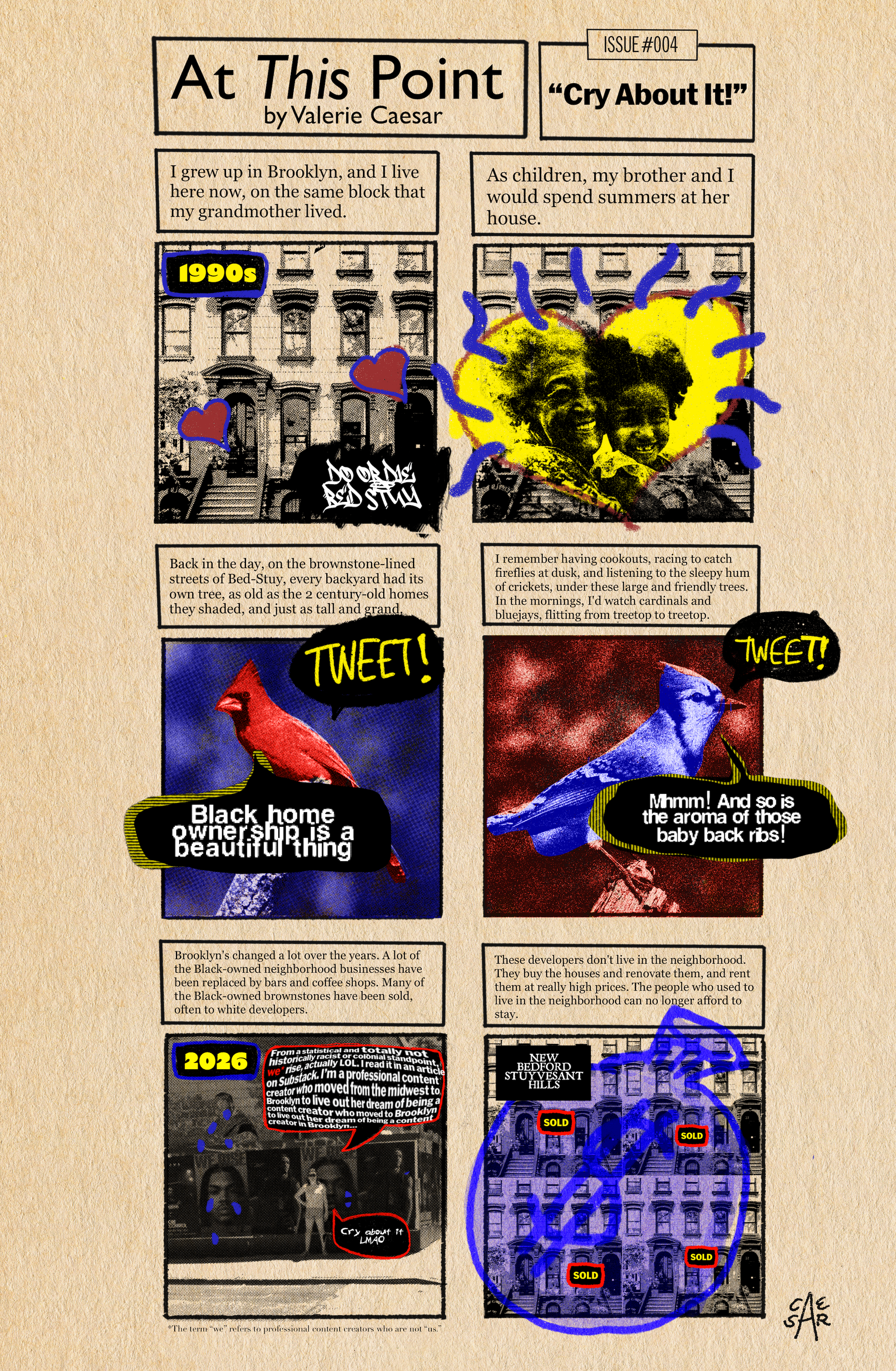
“Cry About It,” Issue #004 | At This Point, Valerie Caesar, 2026.
I’ve been wanting to create another comic for a while. At the same time, I’ve been struggling to healthily process my growing frustration, rage, and grief about the current phenomenon of gentrification running rampant in Brooklyn. As a Brooklyn native, I have deep roots in this city, growing up in Flatbush among my fellow Caribbean bredren, going to schools in Canarsie and Coney Island among Russian Jews and Eastern Europeans, visiting friends and family and living in apartments in Crown Heights, Fort Greene, Midwood, Bed-Stuy, Brownsville, East New York and Bushwick and many other neighborhoods. New York is a liminal space for many; a lodestar for the dreamer. It’s not uncommon for people to pack up and move to New York to live out their dreams. But this particular wave of transplants to Brooklyn in particular feels so aggressive and deleterious in its impact of actually supplanting and displacing the culture it came to live among, ostensibly.
The hard-won cultural presence and legacy in those aforementioned Brooklyn neighborhoods could previously be found in the local businesses that represented those communities: the mom-and-pop eateries highlighting the cuisine of the immigrant populations they served; the barbershops, nail shops, hair salons and braiding shops; the small-owned hardware stores and produce grocers. Most notably, the neat rows of homes in neighborhoods like Flatbush and Bedford Stuyvesant were owned predominantly by hardworking Black Americans and Black Caribbean immigrants, some, like my grandmother, who set down roots in Brooklyn as early as 1970. Their grandchildren, people like me, are first generation Americans, for whom Brooklyn is the first and only home they’ve ever known. It is the efforts of people like my grandmother and her generation that made these communities, neglected by the local government because of racism, habitable and even thriving.
Because of this history, it is indescribably disheartening to look at the Brooklyn of today. Besides the legions of soulless coffeeshops and san-serif-emblazoned, self-important, overpriced, underseasoned eateries, and hordes of pale bodies marching through heretofore Black-owned, graffitied streets and under the latticed, garbage-strewn shadows of the J train overpass on Broadway, there is the more insidious thing going on with real estate.
Prior to the Tiktokification of residential communities, rendering their histories and the impact of this banal tourism no more consequential than a stay at a Disney resort, real estate developers were using illegal and immoral tactics to spread their dominance in Brooklyn like a cancer. They gobble up the generational wealth of these Black communities, by buying out older Black residents and homeowners with confusing and legally conflicting contracts. They obliterate the charming and historical design of these Black neighborhoods by hastily erecting faux-luxury buildings using cheap ugly and discordant materials, and casting dark shadows onto and into the surrounding homes. (Some of these eyesores are being condemned after discovery that they are out-of-code hazard traps.) And many straight out steal homes using methods of deed theft.
This must be how the natives who occupied this land before European settlers came to destroy everything felt. At the time of this writing, I’ve been forced to stay indoors for the past four days, because New York is experiencing the smoky, sooty aftermath of forest fires blazing hundreds of miles away in Canada. The amount of particulates floating in the air is at a dangerous level and it’s not safe to breathe outside for any period of time. We can trace these uncontrollable forest fires directly to the abandonment of deforestation practices perfected by native populations for hundreds of years prior to European control over this land. Watching the country burn because of the ignorance of shortsighted, violent and aggressive foreigners is a tale as old as time, as I imagine the helpless rage I feel witnessing it in my lifetime must also be.
Anyway, this particular comic strip is excerpted from a longer story I wrote about how gentrification contributes to climate change via a particular practice of removing trees from properties to prepare them for the faux-luxury treatment preferred by these modern-day slumlords and the settlers who patronize them. I have written that version of the story (about the murder of a tree for convenience) as a children’s book, but I wanted to use the first few lines to create this comic strip that utilizes different photographic print styles, including halftone rendering and freestyle coloring techniques.
As I was drafting the layout, I realized that the hand-drawn sketches I was making, with their outlined hearts and squiggles, looked very much like the drawings I would create as a child during free time in class. I’d make love notes for my mom and present them to her when she picked me up from school. This memory felt aligned with the comic strip’s message of childhood nostalgia, love and joy that connected me both with my grandmother as well as the Bed-Stuy neighborhood that I grew up visiting her in, so I decided to keep that style as a feature. I also enjoyed using the backyard birds as a foil for some of the more direct ideas and images I wanted to share in a relatively small space.
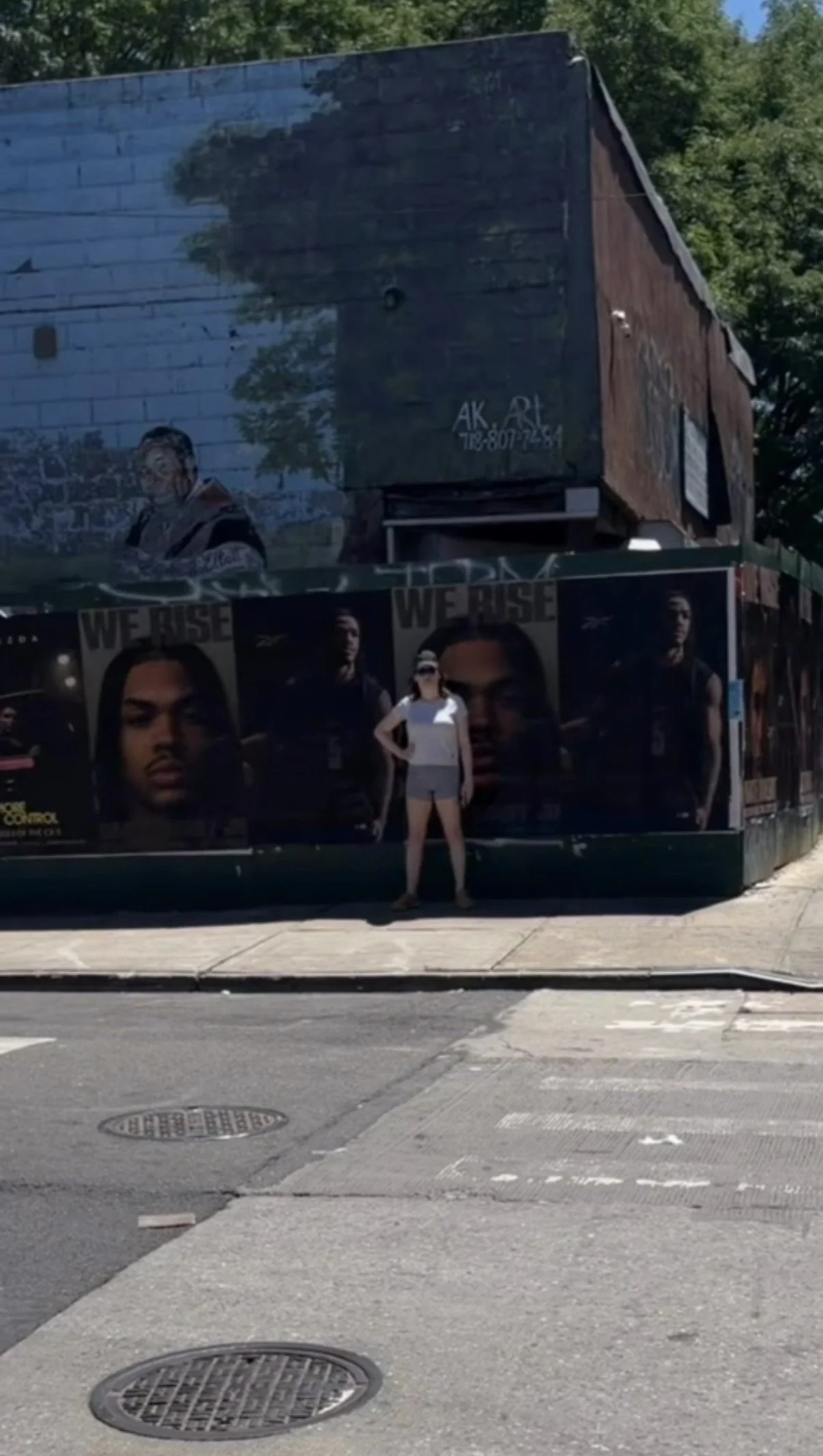
The fifth image in the strip was a photo (shown above) that I snapped of a white girl standing on the corner of Broadway near Decatur Street, under the J train overpass, near an abandoned building. (When rent prices get to be too high, the original owners have to clear out, making way for the new coffee shop du jour. This site used to be a church at which folks would donate tons of used clothing. For at least a couple of years after they were forced to close, people still brought bags of clothing and they would pile up in front of the boarded-up doors. The muscle memory of a community is strong, even when the limb has been severed.)
The symbolic audacity of this pale body standing in front of this old Black church in front of grafitti-ed, wheatpasted signage of Black men, reading “WE RISE” — it was just too much for me. For me, the irony is breathtaking. And I had to draw attention to the stifling circularity of social media presentation and performance that is killing the vitality of native communities in so many places, and in so many ways.
Creating these pieces doesn’t solve the problems that gentrification creates, but it is definitely a cathartic thing for me to do. As Zora Neale Hurston said, if you’re quiet about your pain, they’ll kill you and say you enjoyed it. For the record, I do not enjoy the modern-day imperialism I am witnessing via the gentrification of Brooklyn. But I hope that you enjoy this heartfelt comic, and check out the behind-the-scenes videos below.
A CLOSER LOOK

Watch these short videos at the full screen setting to view both the making of and the final version of At This Point, Issue #004 in closer detail.